
Stormwater & Flood Control
“Historically, Los Angeles’s rapid growth has led to an exacerbated rate of failure. By the turn of the century, the city was running out of water.”
1781
Spanish settlers establish El Pueblo de Los Angeles near the river, using its waters for irrigation and daily needs.
1860
The City of Los Angeles finalizes its inaugural water system, marking a transition from informal water distribution to a structured municipal supply network.
1902
The Los Angeles Department of Water and Power (LADWP) is founded as the city’s official water utility, initially focusing on drinking water rather than flood control.
1913
The completion of the Los Angeles Aqueduct, designed by William Mulholland, diverts water from the Owens Valley, reducing local reliance on stormwater for supply.[2]
1914
A major flood devastates Los Angeles, leading to early flood control efforts like levees along the Los Angeles River.
1915
The Los Angeles County Flood Control District (LACFCD) is created to provide flood protection and water conservation. The city constructs its first reinforced concrete storm drains to move water away from streets and buildings.
1928
The Metropolitan Water District of Southern California (MWD) was established to develop a more reliable regional water supply, later becoming a key player in stormwater reuse efforts.
1938
The deadliest flood in LA’s history results in over 100 deaths and the destruction of infrastructure, prompting federal intervention.
1939
The U.S. Army Corps of Engineers begins channelizing the Los Angeles River, paving large sections with concrete to control future floods.
1952
The Sepulveda Basin is completed, serving as a flood detention area to manage overflow from the LA River.
1972
The Clean Water Act is passed, requiring LA to address stormwater pollution and water quality.
1990
The Stormwater Management Division within the Bureau of Engineering is formed with the responsibility of developing and implementing stormwater pollution abatement projects and programs.
1998
Proposition O is passed, funding stormwater quality improvements, wetlands restoration, and other sustainable projects.
2000
The LA River Revitalization Plan is proposed, seeking to balance flood control with ecological restoration.
2007
The city’s Water Integrated Resources Plan (WIRP) prioritizes stormwater capture for local water supply.
2018
Measure W is approved, providing a long-term funding source for stormwater capture, water reuse, and infrastructure improvements.
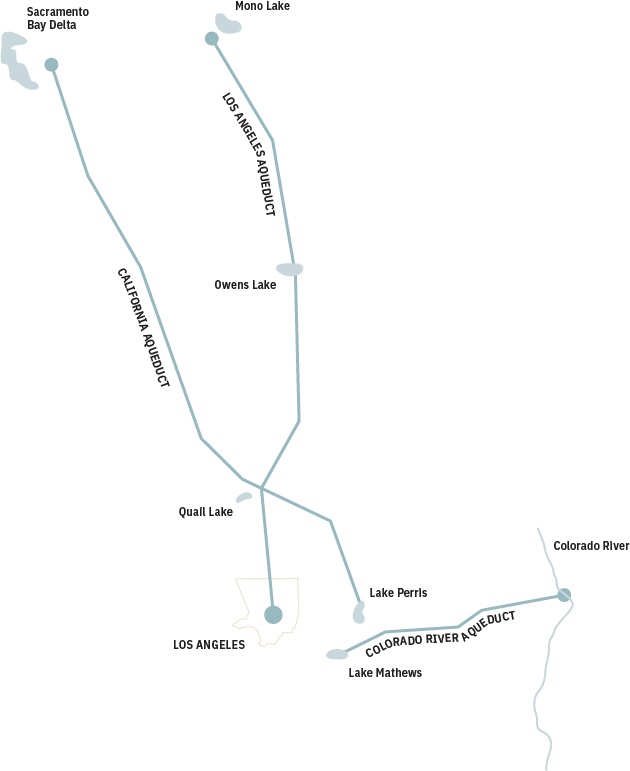
CITY OF LA
IMPORTED WATER
The City of Los Angeles relies on the three aqueducts for roughly 90% of its water supply.[3]
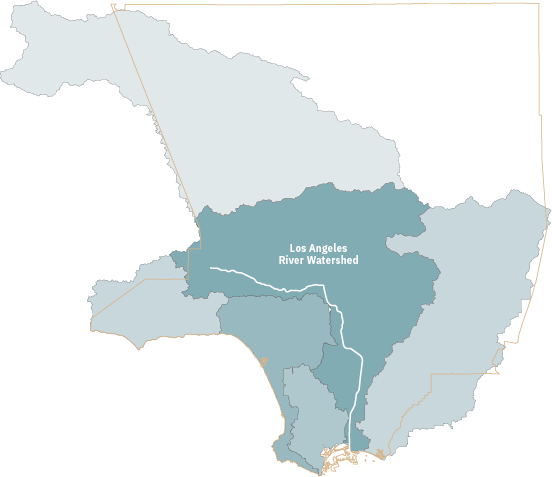
LA COUNTY
WATERSHEDS
A watershed is an area of land that drains all the streams and rainfall into a common outlet, like a lake, river, or ocean. Water falls as rain or snow, and then flows downhill, coming together as streams and rivers, and eventually downward through the watershed into a body of water.
The Los Angeles River Watershed is 834 square miles. The watershed’s land is put to many different uses, with hundreds of miles of forest and open space, hundreds of thousands of homes, streets, freeways, factories, farms, and apartment buildings. [4]
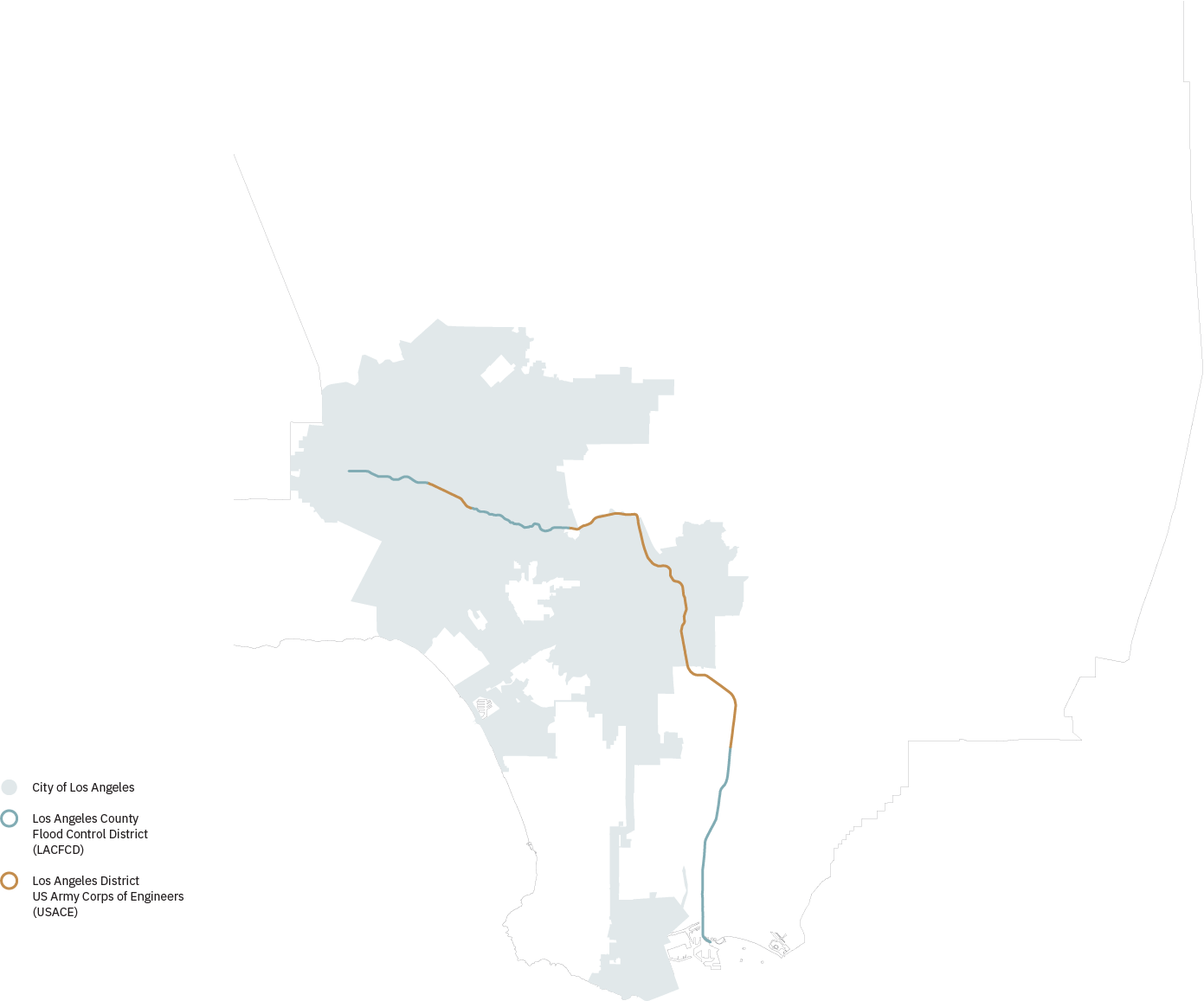
LA RIVER
JURISDICTION
Currently, the operations and maintenance of the LA River and its tributaries are shared by the LA County Flood Control District and the US Army Corps of Engineers.
Ownership of the approximately 2,300 acres of land within the LA River ROW varies. The LACFCD owns the largest portion of the ROW, but the USACE, municipalities, and private owners also own portions of the ROW.[8]
LA COUNTY
WATER SUPPLY
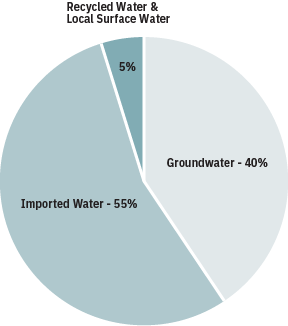
The water supply of Los Angeles County is a diverse mix of groundwater, surface water, imported water, and recycled water.[9]
However, less than 50% of the region’s water supply is from local sources.[10]
WATER
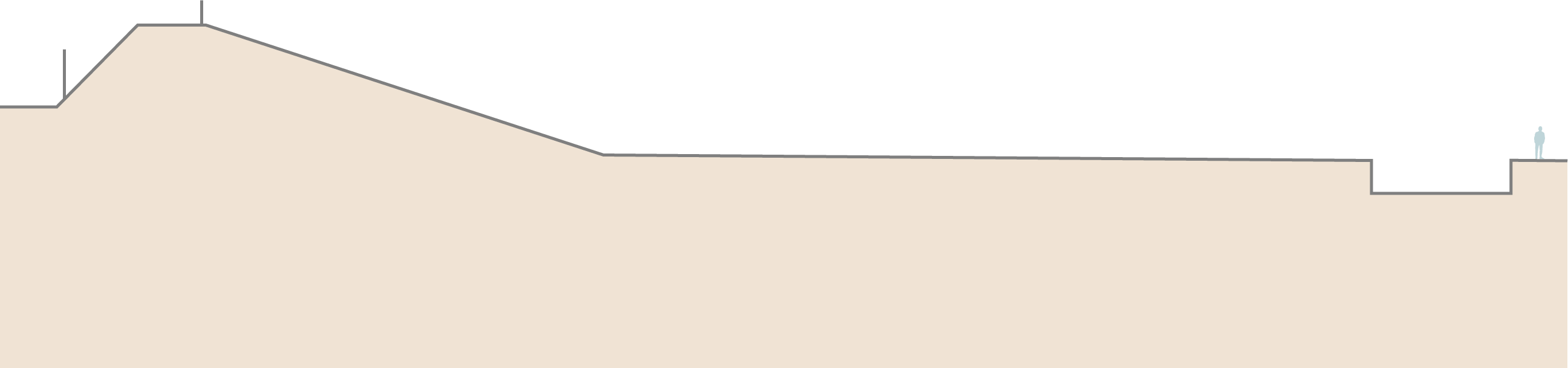
ABRIDGED DRAWING
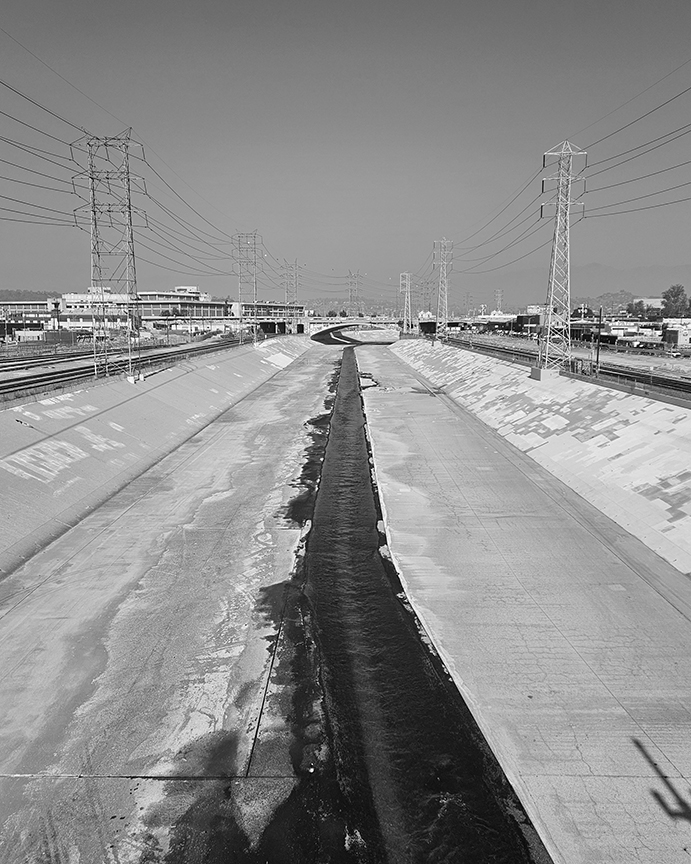
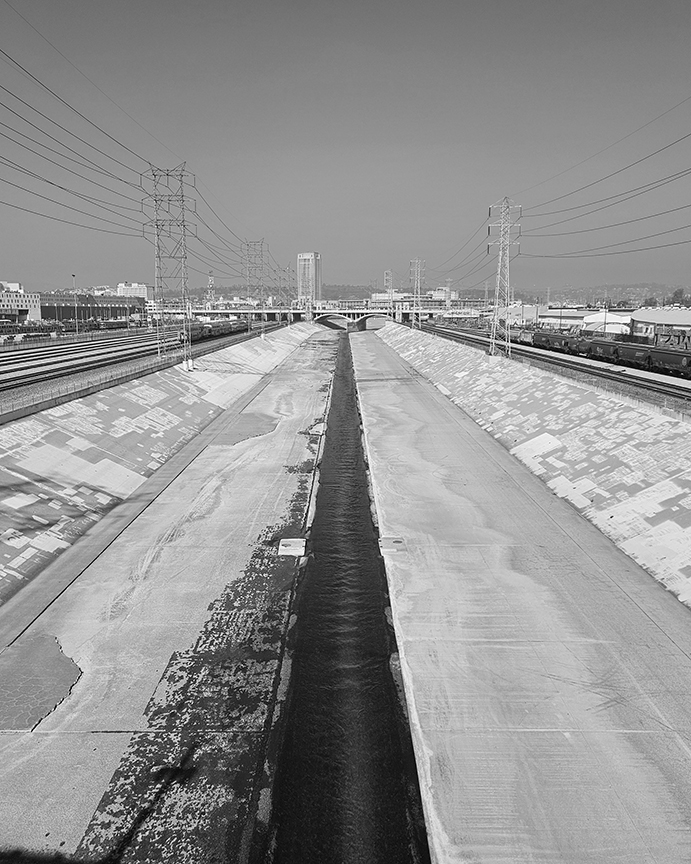
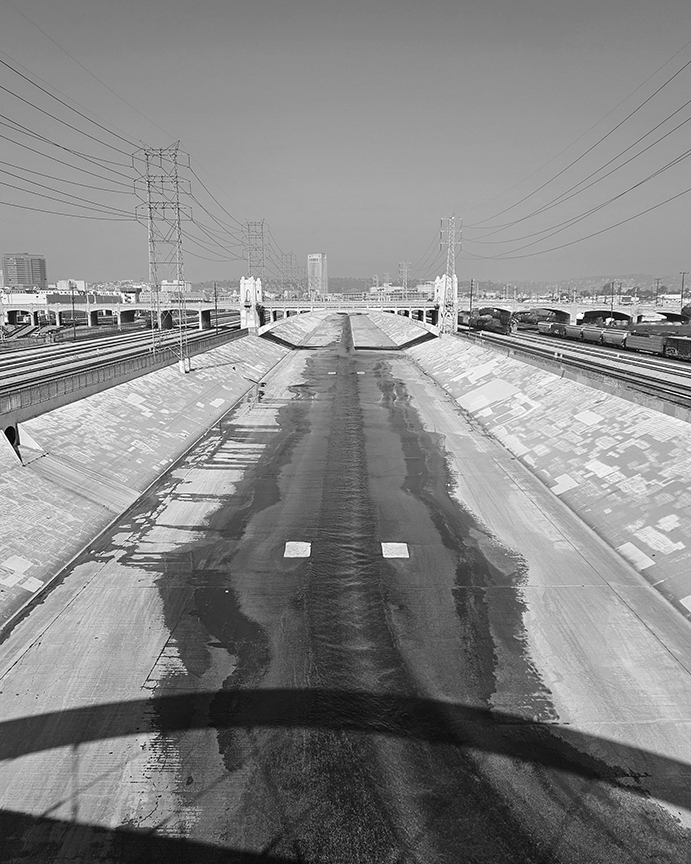
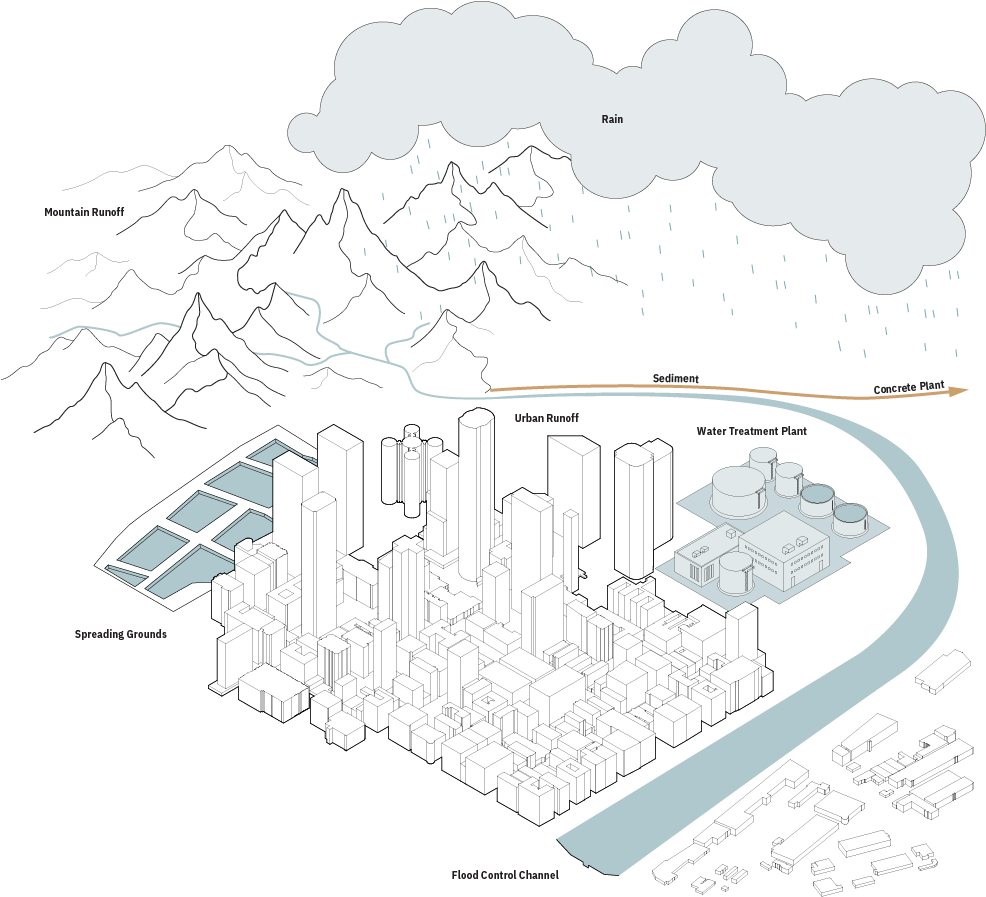
The aggregate that makes up the walls of the Los Angeles River is also brought by the sediment that it carries down from disintegration of the mountains.[11]
INFRASTRUCTURE
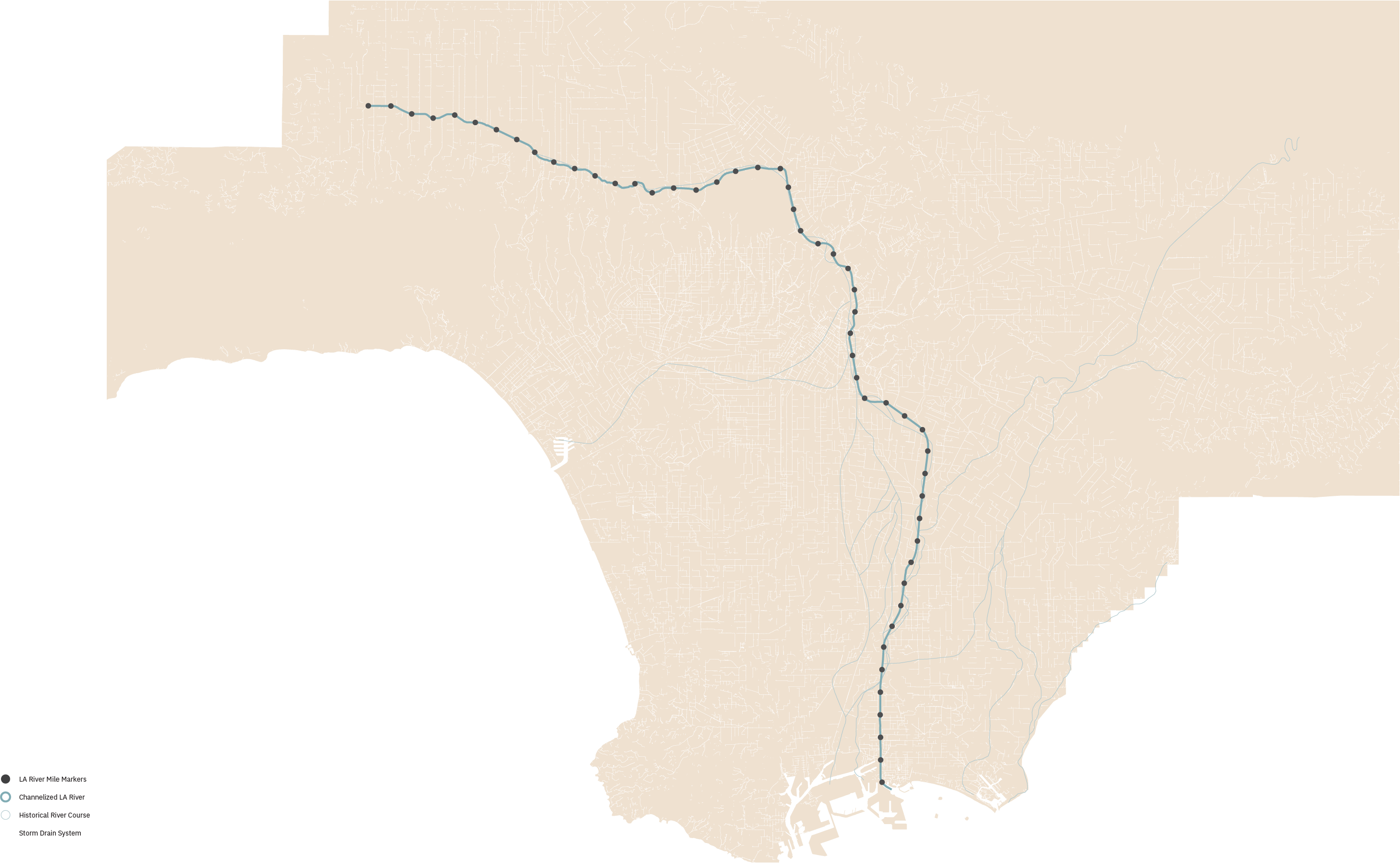
LOST WATER
When the U.S. Army Corps of Engineers built the channel, its sole purpose was to drain water through the city and to the ocean as quickly as possible to prevent flooding.
However, as a result, 80% of valuable rainwater is still dumped into the ocean every year. [12]
At the end of LA County’s 2024 storm season, more than 96.3 billion gallons of stormwater were captured and stored within the county’s reservoirs and delivered to spreading grounds for recharge of groundwater aquifers.
During that period. LA County harvested enough water to meet the needs of more than 2.4 million people for a year – about 24% of the region’s annual demand.[13]
INFRASTRUCTURE
WEIGHT
SOLID // HEAVY
Construction on various flood control projects for the Los Angeles, Rio Hondo, and San Gabriel Rivers collectively poured more than 4,000,000 tons of concrete and placed nearly 75,000 tons of reinforced steel.
It is equivalent to roughly 1.5 concrete Empire State Buildings and 85% volume of the Statue of Liberty.
LIGHTWEIGHT // ABSENT
Construction on the various flood control projects also displaced more than 23,000,000 tons of earth.[6] The LA River also averages a daily discharge of over 200 million gallons of water per day.[7]
It is equivalent to filling roughly 6 Great Pyramids of Giza with earth and filling 2.5 Rose Bowl Stadiums with water
INVISIBLE // SOCIAL
Approximately 62% of the watershed is developed with mixed land uses.
Pollutants including bacteria, nutrients, oil and grease, trash, and trace metals, typically generated from land use activities, can be mobilized by dry and wet weather runoff and transported into the LA River, leading to degraded water quality and creating negative impacts on the aquatic ecosystem as well as human use of the waterway.
When broken down into 1 mile sections, it is estimated that each mile of the LA River would contain approximately 78,000 tons of concrete and 1,500 tons of reinforced steel.
WEIGHT
DEFINITION
While water can be measured in pressure, volume, or flow, this proposal defines the weight of infrastructure as something else entirely: the potential water that has been lost or mismanaged as a result of outdated systems.
This netting strategy aims to make that weight visible—and reclaimable.
Stormwater & Flood Control Proposals
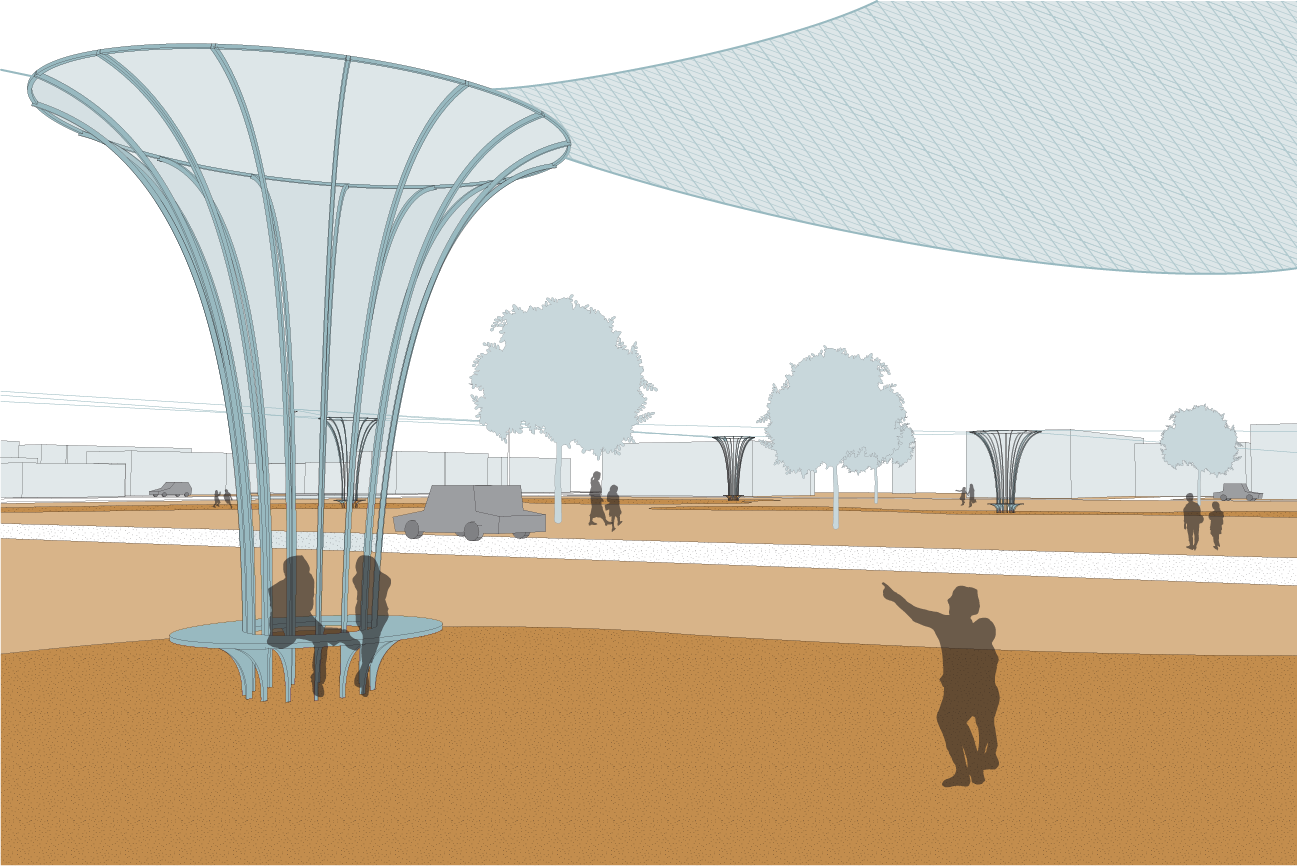
In Los Angeles, our relationship with water is narrowly defined – we only engage with it once it reaches the ground, channeled into engineered flows. This proposal challenges that limitation by expanding from the existing boundary of human interactions we have with water.
Through a network of Aerial Stormwater Nets suspended across the urban fabric, we seek to expand our interaction with water into the sky itself, capturing atmospheric moisture and rainfall before it ever touches the surface. By doing so, we dissolve the invisible boundary that has confined our hydrological infrastructure to the ground, opening new spatial and temporal dimensions for flood control, recharge, and urban weathering.
PROPOSAL
VACANT LOTS
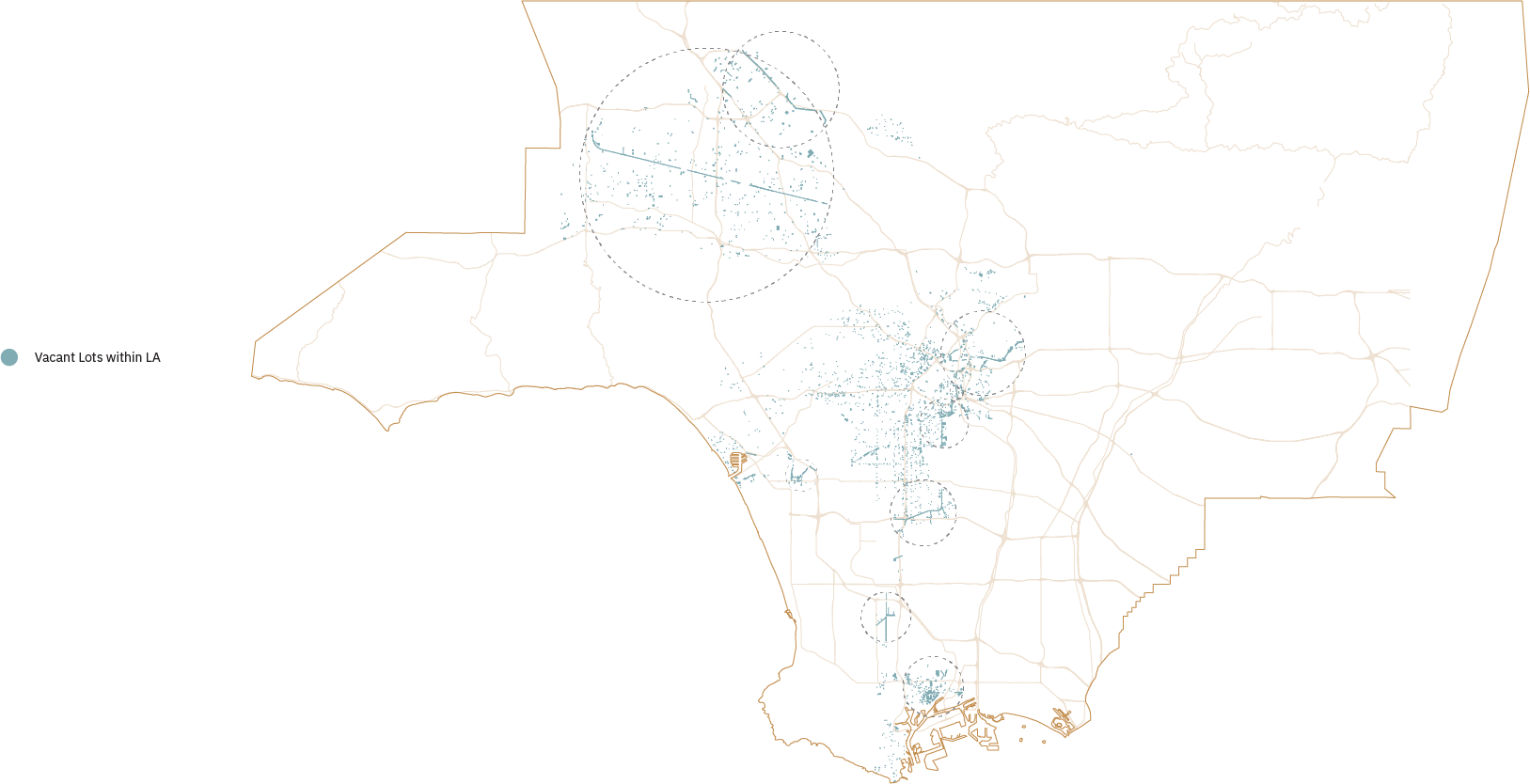
As part of the deployment strategy for the stormwater nets, vacant lots across Los Angeles are reimagined as critical ground interfaces.
Often overlooked or underutilized, these unpaved spaces offer ideal conditions for water percolation and deep soil infiltration. By anchoring stormwater nets above these sites, we create vertical access points that connect atmospheric moisture directly to permeable land. This coupling of sky and soil transforms vacant lots into active infrastructure, turning absence into opportunity and reclaiming space for hydrological recovery.
PROPOSAL
POWER LINES
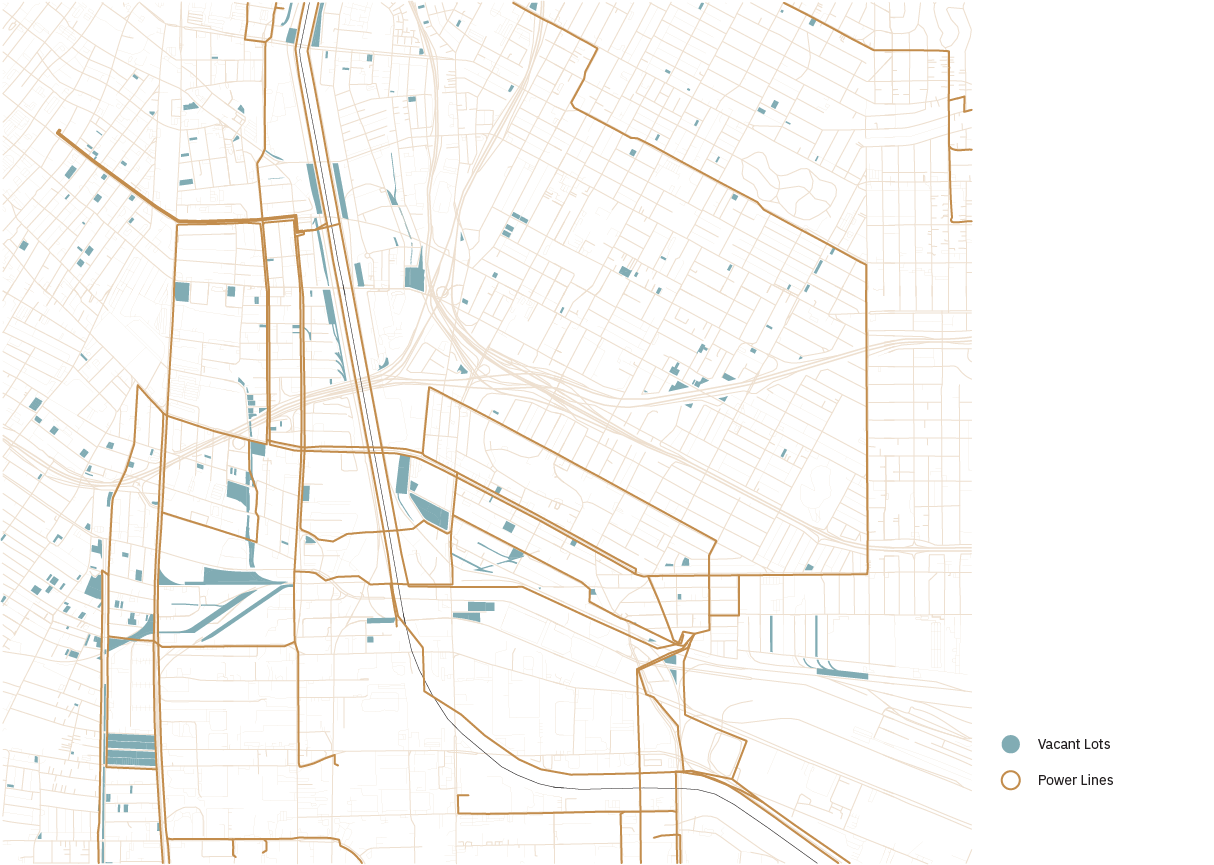
Rather than defaulting to wholly new construction, this proposal aims to leverage existing powerline corridors as tethering points for the Aerial Stormwater Nets. These corridors, which are often underutilized and restricted in use, offer a vast spatial network already embedded in the urban landscape. By suspending the nets from these transmission lines, the project aims to reclaim infrastructural redundancy, transforming our passive overhead networks into a hydrological system.
This approach minimizes new material use, shortens deployment timelines, and avoids further land disturbance. More critically, it reframes how we perceive legacy infrastructure: not as fixed and singular, but as an adaptive framework.
COMMERCIAL
SINGLE LOT
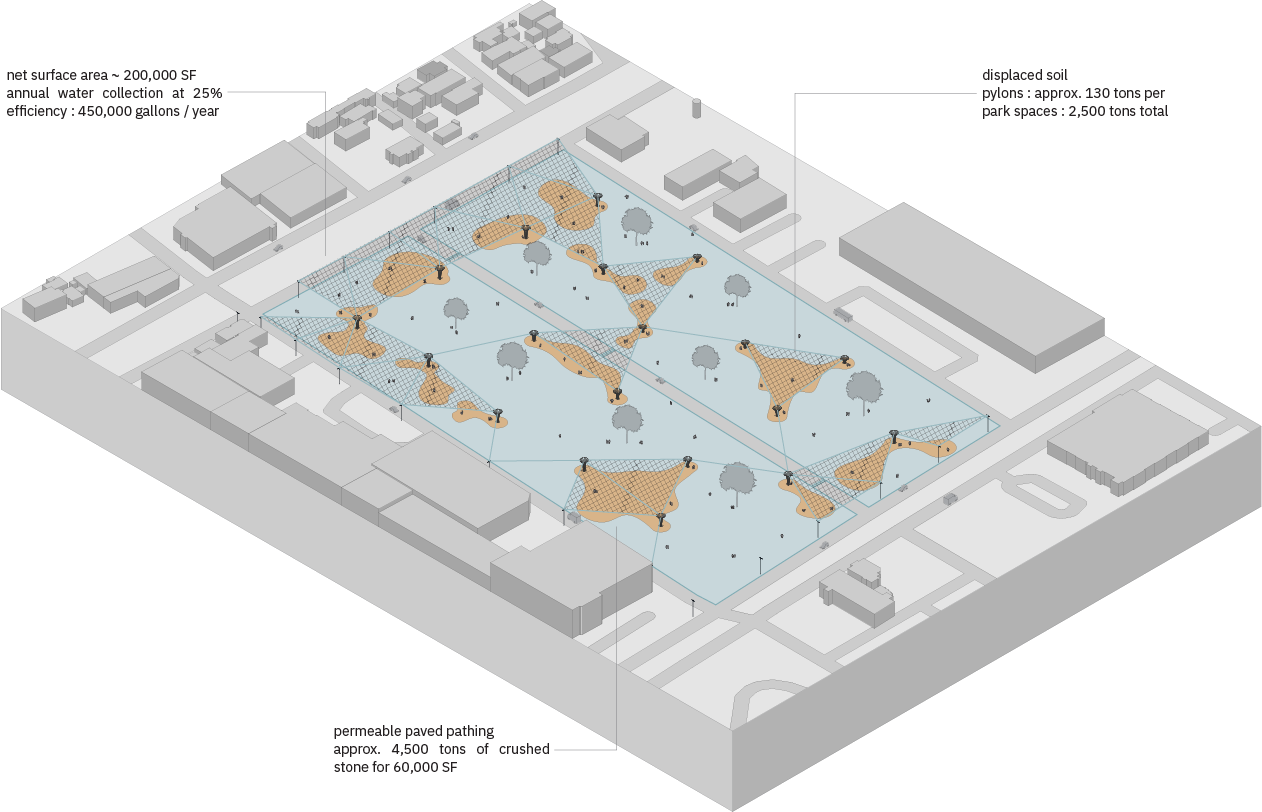
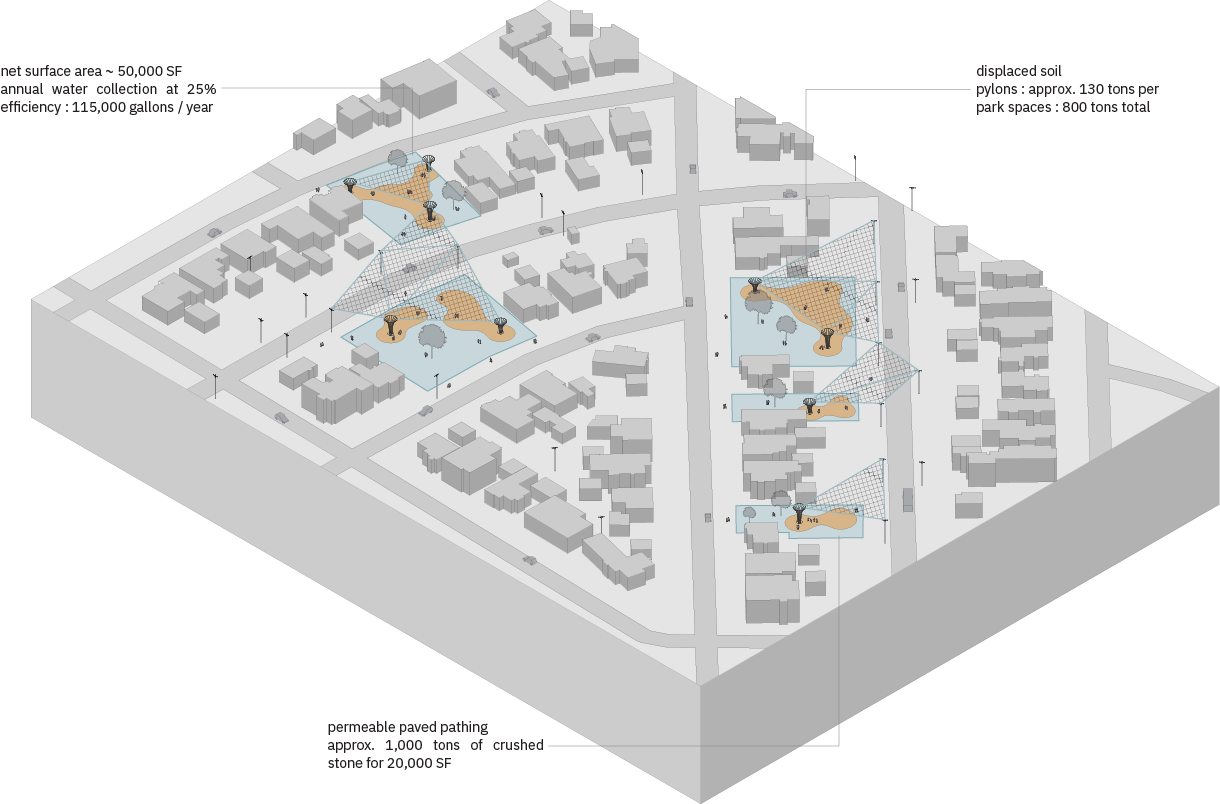
In large commercial lots, the Aerial Stormwater Nets are deployed as high-volume collection systems. Elevated net arrays harvest atmospheric moisture and direct it downward through pylons that double as structural anchors and mechanical infrastructure. Inside each pylon, a pump system transfers the collected water into subgrade recharge shafts, ensuring direct infiltration into the aquifer below. Beneath the net canopy, former heat islands are reimagined as shaded community parks with permeable paving that supports both infiltration and recreation. Areas not covered by nets are converted into green gathering spaces landscaped for play and passive use, where community members can witness the collection and recharge process in real time.
RESIDENTIAL
LOT CLUSTER
In residential neighborhoods, where lots are smaller and scattered, the nets are anchored across clusters of adjacent parcels and underutilized spaces. Each pylon similarly serves as a physical support and a mechanical pump system, moving collected water from above into subsurface infiltration zones, bypassing surface runoff routes and delivering moisture directly to the aquifer. Beneath the netting, intimate park spaces with permeable paving emerge – designed for gathering, rest, and everyday neighborhood use. Open, uncovered areas are converted into planted commons that absorb overflow and support play and recreation.
PROPOSAL
FUTURE
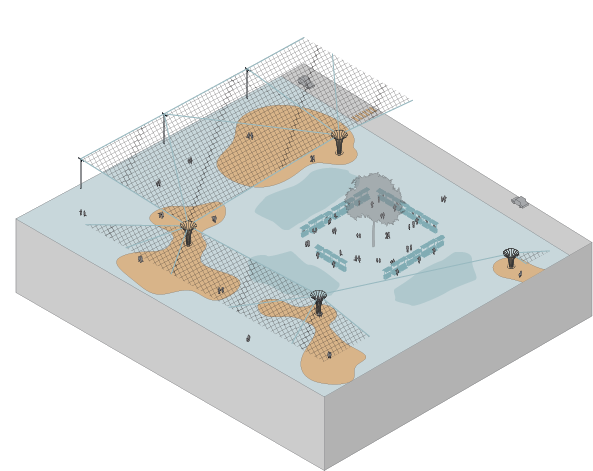
YEAR 5: SEEDING COMMUNITY & ECOLOGY
In the early phase, the site begins its transformation with the introduction of native vegetation to boost biodiversity and reduce the urban heat island effect. A community garden and seasonal farmers market activate the space, establishing it as a social and ecological hub. While only operating at 25% efficiency, they lay the groundwork for a system that is as much about stewardship as it is about capture.
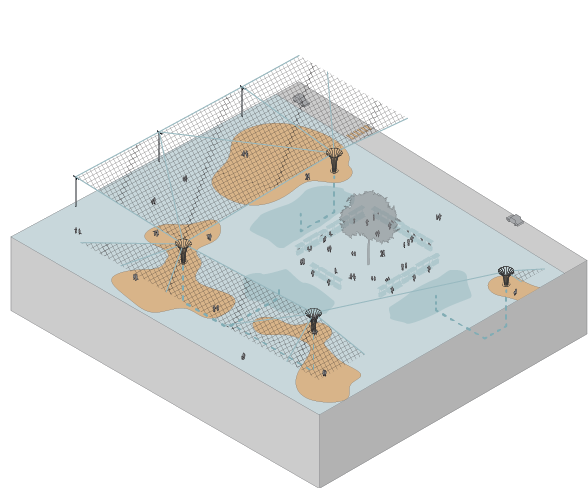
YEAR 15: RESPONSIVE SYSTEMS & SELF-SUSTAINING LANDSCAPES
The site matures into a semi-autonomous climate system. Smart irrigation fed by captured water now supports robust native plantings and small-scale urban agriculture. The community thrives in a greener, cooler environment with reduced dependence on city water. Net efficiency rises to 35%, and the system begins to adaptively manage itself based on real-time conditions.
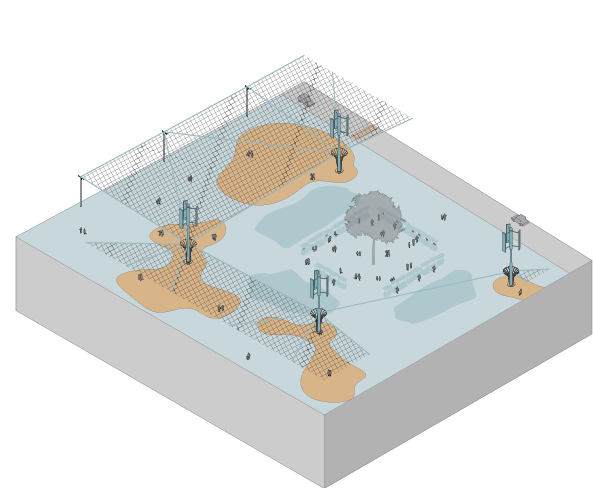
YEAR 50: INTEGRATED POWER, WATER, AND PUBLIC LIFE
The site becomes a fully integrated environmental machine. Pylons no longer support just mechanical water pumps, but also wind turbines, producing energy to sustain the system itself. At 65% net efficiency, the infrastructure is not only harvesting atmospheric moisture but generating power, supporting life, and anchoring a new model of public space.
Sources
- “History: City of Los Angeles Stormwater Program,” lastormwater.org, May 31, 2024, https://www.lastormwater.org/about-us/history/
- “Water and Power Associates Informing the Public about Critical Water and Energy Issues Facing Los Angeles and California,” Water and Power Associates, accessed April 14, 2025, https://waterandpower.org/museum/Water_in_Early_Los_Angeles.html
- Colinhoag, “The Meanings and Limits of ‘Local Water’ in Los Angeles,” Engagement, July 29, 2020, https://aesengagement.wordpress.com/2018/12/11/the-meanings-and-limits-of-local-water-in-los-angeles/
- “Watersheds,” Water for LA County, May 8, 2024, https://waterforla.lacounty.gov/watersheds/
- Annelisa Moe, “The Secret Life of La Stormwater – Heal the Bay,” Heal the Bay – Environmental Nonprofit Protecting Ocean & Watersheds in Greater Los Angeles, California, November 26, 2019, https://healthebay.org/secret-of-la-stormwater/#:~:text=Two%20main%20types%20of%20water,overwatering%20lawns%2C%20or%20washing%20cars
- “The La River and the Corps: A Brief History,” Los Angeles District, October 3, 2013, https://www.spl.usace.army.mil/Media/News-Stories/Article/477249/the-la-river-and-the-corps-a-brief-history/#:~:text=To%20some%2C%20it’s%20nothing%20more%20than%20a,that%20splits%20the%20concrete%20jungle%20in%20two.&text=The%20district%20hired%2014%20contractors%20in%2031,460%2C000%20tons%20of%20grouted%20stone%20slope%20protection
- “La River Facts,” LA River Facts | Los Angeles River Revitalization, accessed April 16, 2025, https://lariver.lacity.gov/la-river-facts#:~:text=Elevation%20at%20Origin%20(Canoga%20Park,80%20schools%20(2004%2D5)
- “Jurisdictions, Ownership, and Rights,” LA River Master Plan, accessed April 15, 2025, https://larivermasterplan.org/about/master-plan-2022/jurisdictions-ownership-and-rights/
- “Water Supply,” LA County Public Works, October 22, 2024, https://content.pw.lacounty.gov/core-service-areas/water-resources/water-supply/
- “Existing Water Supply,” LA River Master Plan, accessed April 16, 2025, https://larivermasterplan.org/about/existing-conditions-summary/existing-water-supply/
- “Matthew Coolidge, Margins in Our Midst (Los Angeles: Center for Land Use Interpretation, 2005).”
- Mara Katherine, “Unearthing Potential: The Evolution of the Los Angeles River,” Kinute, November 7, 2023, https://kinute.com/stories/650280291-unearthing-potential-the-evolution-of-the-los-angeles-river#:~:text=As%20a%20result%20of%20misconception,into%20the%20ocean%20every%20year
- County Of Los Angeles, “County of Los Angeles,” COUNTY OF LOS ANGELES, March 25, 2025, https://lacounty.gov/2024/05/08/la-county-ends-storm-season-with-96-3-billion-gallons-of-captured-stormwater/#:~:text=LA%20County%20Ends%20Storm%20Season,Stormwater%20%E2%80%93%20COUNTY%20OF%20LOS%20ANGELES